The Lines That Remember
Juanita Kaye
They say we’ve fixed the world, and I suppose in many ways that’s true. It didn’t happen all at once, and no one can pin point the exact moment it happened. A little more efficiency. A little less inconvenience. Better systems, better access, better outcomes. Over time, those small improvements led us to a world that is almost unrecognisable from what it was before. Now there is very little that cannot be reached and almost nothing that cannot be experienced exactly the way you want to experience it.
You don’t go somewhere anymore, not really. You access it. If you want to stand in the outback at sunset, you can do it without the scorching heat pressing into your skin, without the flies, without the long, quiet drive that leaves you alone with your thoughts. You can deepen the colour of the sky if it feels underwhelming, soften the light, add a breeze, remove it again. And if you want to walk through a place that no longer exists, you can. Perfectly reconstructed. Every surface mapped, every sound layered, every detail corrected until it plays out with your own version of perfection.
It’s all there.
Complete.
And because it works, no one really questions it anymore.
But I do. I question. Sometimes I think that in making everything so perfect, by curating everything to suit the whims of every individual, we’ve lost something that really matters. Something I don’t have the words for.
Art has changed too. Dramatically. It hasn’t disappeared – in fact if anything, there’s more art than ever! But what it means to be an artist and the way art is made has shifted so much the old ways of creating seem archaic and primitive. There are no studios in the old sense. No canvases leaning against walls, no paint drying unevenly, no pencils worn down through use by hands that didn’t know what they were doing to begin with, but that learned through practice. There is no physical struggle with materials, no time spent learning how to control something that doesn’t quite want to be controlled.
Everything is done through prompts and systems and everything comes quickly, in an instant.
You construct an image in language. You layer tone, style, texture, era, emotion. You refine your words until they feel precise enough to carry the idea in your head, and then you send it through. The system generates the image instantly, and if it isn’t right, you simply adjust the prompt. Change a word, shift the tone, remove something, add something else. You can repeat that process endlessly without cost or consequence. Nothing is ever ruined. Nothing is ever truly at risk.
The new systems being released bypass language altogether. You don’t even need to describe the image anymore; you simply think it. You hold it clearly enough in your mind, and the system reads that thought and produces it directly. No translation. No delay. No gap between intention and result.
People say it’s the final step, that its pure creativity, that it levels the playing field and makes us all into artists. There’s no gap between the idea and the creation.
But every time I hear that, I feel something pull back inside me, because it seems to me that whatever used to exist in that space between the idea and the image - the effort, the hesitation, the decisions that couldn’t be undone, the something that used to exist there has been removed entirely. I’m not sure that’s a good thing.
They say I’m a pretty good artist, which means I’m good with prompts. I know how to shape language so the system gives me what I want. I know how to build something that appears to carry history, how to introduce imperfection in a way that feels convincing. There are entire frameworks for that now. You can ask for subtle irregularities, for uneven lines, for the suggestion of something handmade, and the system will give it to you.
But even though people respond to the images I produce, they still feel empty to me.
There has always been a distance between me and everyone else - everything else. I feel as though I don’t quite fit anywhere, though I don’t know if I really even want to. I mean, I function well enough, I produce what I need to produce, but I have never fully settled into the way the world now expects to be experienced. Most people no longer go outside in any meaningful sense. Why would they? There is no need. The environments they access are better, cleaner, safer, more controlled. If something feels off, it can be adjusted.
But I go anyway. Something in me draws me to the outside in a way that feels important. Like it’s where I’m meant to be.
People don’t quite know what to make of that. No one really teases me about it, there’s no real unkindness (not to my face anyway!) but there is always a pause when I mention it, when I talk about the pull to go outside, when I tell stories of my experiences in the real world. It’s just a slight shift in the conversation, a look on their faces, an adjustment in their posture that suggests they think I’m weird. My brother is more direct.
“You’re a weirdo! Why would you waste all that time wandering outside, getting dirty, sweating in the heat, wasting all that energy? No one cares about those places out there! I don’t get it girl. Why are you like this?”
I don’t answer him. I don’t think I can answer him in any way he would understand. I don’t understand it myself.
The prospector’s camp wasn’t marked and wasn’t in the system, which is why it still stood untouched by anyone or anything but time. If it had been considered important, it would have been mapped, reconstructed, turned into something people could access without ever needing to go there. Instead, it had been left just as it was, being slowly dismantled and reclaimed by the natural world.
What was there was no more than a scattering of shacks that sat low against the land, their colours softened into the same earthy red tones as the iron rich earth around them. Corrugated iron bent and rusted, timber frames leaning and crumbling, everything carrying that sense of having been used for as long as it was needed and then simply left behind. Behind it rose the headframe, dark and skeletal, cutting into the sky with a kind of stubborn permanence.
It felt quiet, but surprisingly, not empty.
I didn’t log it. I never logged the places I found.
I moved through the camp slowly, not because I needed to but because it didn’t feel right to move too quickly. There was nothing to optimise, nothing to improve. You just looked, and let things reveal themselves in their own time. And it was there, inside one of the shacks that I found the picture.
At first it didn’t register as anything significant. It was leaning against the wall, partly covered in something that used to be fabric. Something about it held my attention just enough that I stepped towards it, removed the fabric that disintegrated in my hands, and picked it up. When I lifted it, I noticed the weight of it first, then the smell.
It wasn’t unpleasant, but it was unfamiliar. It was a dry, layered smell. Paper that had aged slowly? Ink that had settled into fibres over time? A faint trace of dust and timber and something else I couldn’t quite name. It was the smell of something that had been there for a long time, unchanged. Not preserved. Not restored. Just… existing.
Nothing in my world smelled like that. Everything we access is clean. Neutral. Controlled. Even when scent is simulated, its deliberate and chosen and designed to enhance the experience. This wasn’t that. This was incidental. Accumulated. Real.
I found a rusty nail on one of the walls and hung the picture by the wire on the back, then stood back to take it all in.
It was a drawing of a building. The Exchange Hotel.
Even without knowing the building, you could feel what it was. Not just a structure, but a place where people had gathered. A place where time had been spent in company, where voices had filled the space, where things had happened without needing to be recorded.
As I looked, I found myself almost able to hear it. Not clearly, not like the layered soundscapes we construct now, but faintly, as though the sound existed in the ink. The murmur of conversation. The clink of glasses. A chair scraping against timber. Someone laughing, someone arguing, the creak of door hinges as people came and went. It felt as though the drawing itself held the sounds.
The lines drew me in next. They were not perfect, and they didn’t try to be. They moved, hesitated, thickened where the hand had paused, thinned where it had moved more quickly. They showed the process rather than concealing it. There were faint traces where lines had been erased. Not cleanly. Not completely. Soft ghost marks where the artist had changed their mind, where they had tried again, where something had not quite worked.
The picture recorded all the mistakes, all the decisions, all the improvements. Even the corrections had been carried forward. Nothing had been fully removed. There was no perfection. That struck me more deeply than anything else.
The longer I looked, the more I became aware of the person who had made it. Not in any factual way, but in the way they had seen. The parts they lingered on. The parts they moved through more quickly. The way the lines around the entrance were thicker and more pronounced, as if it mattered more.
Standing there, in that shack, it occurred to me that the person who drew this might have been one of the prospectors who lived and worked in this place. In this real place full of real things. Maybe he worked the mine by day, in the real heat, doing real work, and his nights were filled with darkness and time and quiet.
Perhaps there had been a night when he had sat with paper and pen, by the light of a kerosene lamp and drawn this hotel from memory. A memory of the hotel itself, the people, the sounds, the smells. He had definitely been to this place. Maybe he missed it. Maybe he looked forward to returning there again some day.
I sat down on the dusty floor and stayed there for some time. What I was looking at was not just an image. It was a moment that had been allowed to remain exactly as it was made, carrying the presence of the person who had made it.
It felt alive in such a quiet, honest, real kind of way.
The decision to leave it there and not take it with me to be entered into the system came easily, without much thought. The picture belonged to that place and to the conditions that had allowed it to survive. To move it would have been to change it, to log it into a system that would alter the way it existed seemed so very wrong.
When I returned home, everything felt too immediate. Too ready to respond. The interface waited, the prompt field lay open, expecting input. For the first time in a long while, I did not know what to write. Every attempt felt like a cheap imitation of something I had only just begun to understand.
I stared at the screen for the longest time feeling something I’d never felt before and couldn’t quite articulate. It was a kind of emptiness, a kind of sadness, mixed with something else… hope maybe? Purpose?
And then I remembered the box.
It had been given to me when my grandparents’ house was cleared out after Grandad passed away and Grandma was moved into care. She had been an artist as a young woman. No one else wanted the box or any of the contents. There was no use for those kinds of things anymore. I had taken it without knowing why but had never opened it. That was over a decade ago.
When I lifted the lid, the smell of the paper instantly transported me back to that prospector’s camp and to the picture I had found. It transported me in a way none of our VR experiences or perfectly curated access sessions ever could. Along with several pads of paper was a collection of pens and pencils in various states of use. Some worn down, some barely touched. I picked one up and felt immediately how different it was. It did not respond. It did not adjust. It simply existed, waiting. It felt strange and new, but at the same time, almost familiar.
I sat down and placed a sheet of paper in front of me.
Whatever I did next would remain.
There would be no undo. No refinement. No second version waiting behind it.
The blank page was intimidating and exciting and stirred something in me that made me breathless. I must have sat looking at that blank page and feeling that pencil in my hand for a full minute, frozen in some kind of trance.
When the trance broke I finally made a mark. It was uneven. Slightly too heavy at the beginning, lighter toward the end. It carried my hesitation, my uncertainty.
And it stayed.
I looked at that single line on that white sheet of paper, slightly yellowing at the edges, for a long time, knowing that it held the moment I made it, exactly as it had happened.
And in that moment, I understood.
The drawing in the shack had not just captured a building, or even the feeling of that place. It had held a person. Their decisions. Their hesitation. Their attempt to remember something that mattered.
Now, in a much smaller way, this line held me. It held my attempt to remember something that mattered and for the first time, I felt that I had truly created something. Not something that was perfect, not something optimised, but I had made s
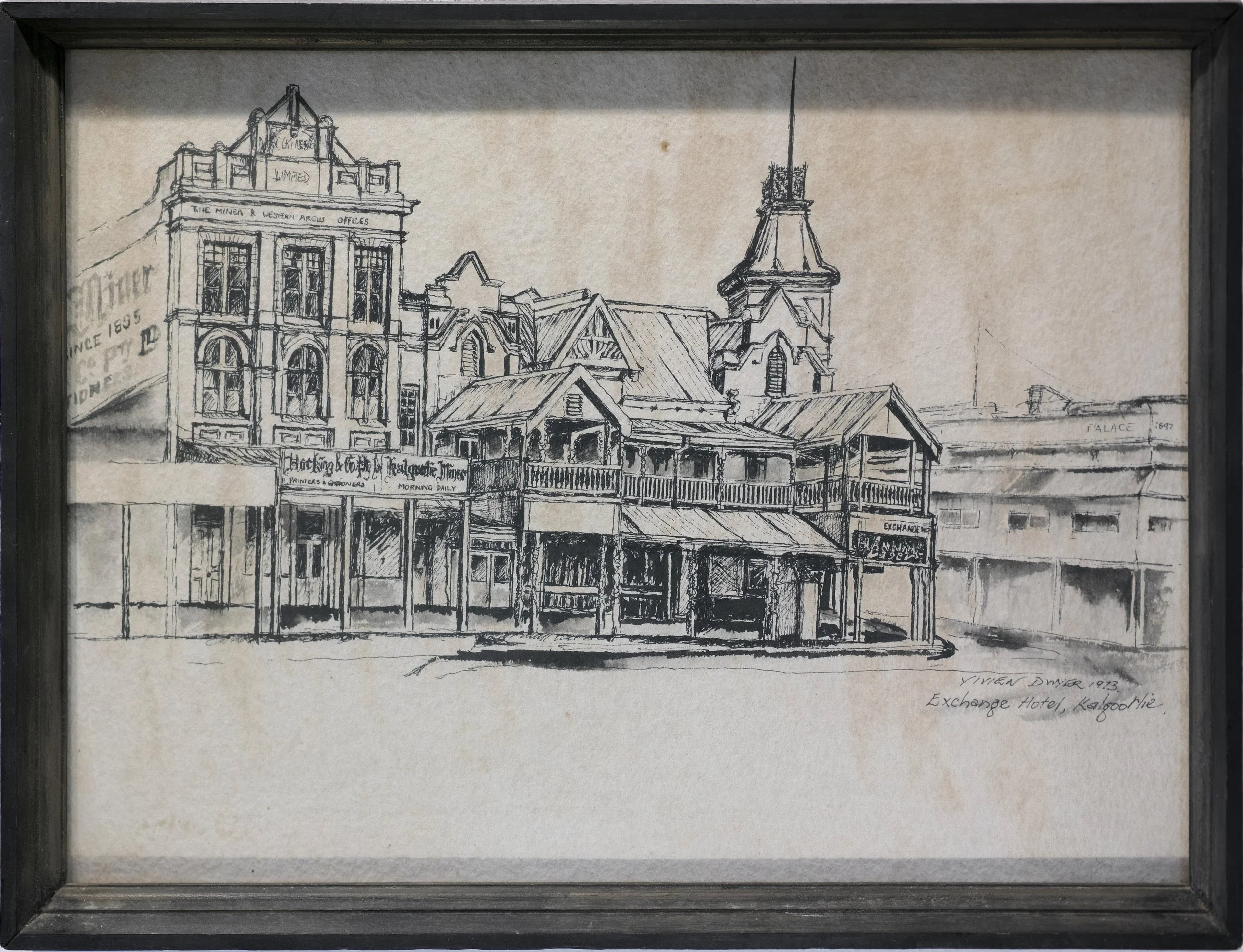
Vivien Dwyer
Exchange Hotel Kalgoorlie
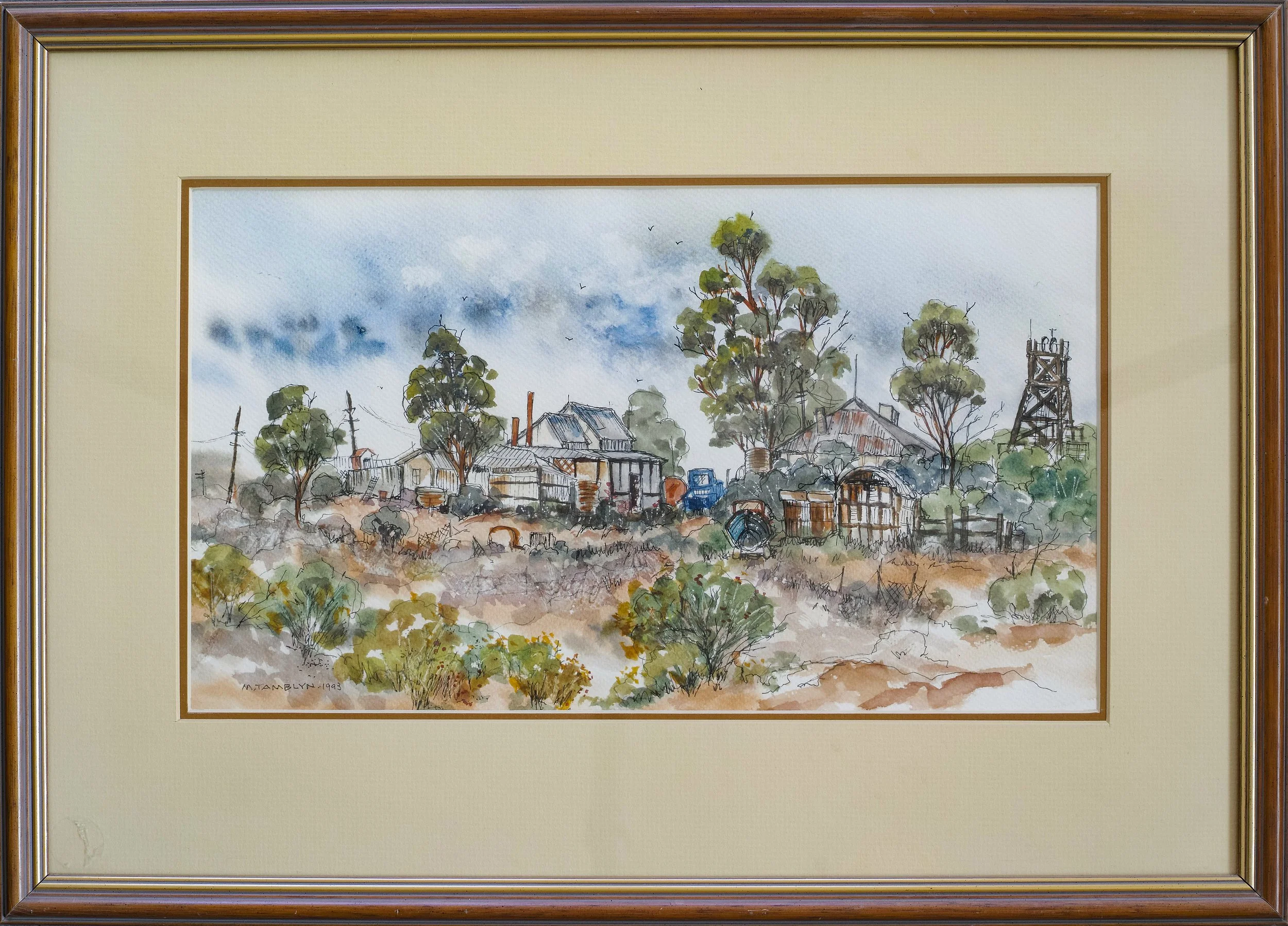
Prospecting Camp
Moya Tamblyn
I chose these images because they feel like they hold something. The prospector’s camp carries a quiet sense of isolation, while the Exchange Hotel suggests noise and connection. That contrast interests me. The tension between opposites is something that inspires me. It led me to think about how things are made, and what might be lost when that process disappears, which we are witnessing take place first hand.
Juanita is an all-round artist who works across writing, visual art, sculpture and performance. Drawn to abstract ideas, she enjoys exploring paradox, new concepts, and new ways of thinking. With no formal arts training, but an abundance of curiosity, she approaches everything as an experiment, never quite knowing where it will lead. Rather than following rules or fixed forms, she lets ideas guide the process, pushing boundaries and moving between mediums freely. At the core of her work is a love of exploration and a willingness to see what happens when you simply begin.