


Touchstones
Carolyn Wadley Dowley
She imagines them passing her photo from hand to hand: 'Which one is she?'
'That one in the middle, the blond one.' 'The blond one?'
Long pause, scrutiny.
Verdict: 'Doesn’t look much like anyone in our family.' 'Pass it over here. Oh!! What’s her name again?' 'Teresa.'
'Margaret’s daughter, is she?'
She turns over and tries to dispel the scene from her mind. Go back to sleep, she tells herself.
---
She’s packing clothes, almost randomly. She stops a moment, the small bag open on the bed in front of her, warding off the feeling that time and events are bearing her away, sweeping her in a direction that is way off the expected course. Where will it end, her mother had asked.
I can always come back, she says to the thought of her mother. I am coming back in two days.
---
They stop to refuel the car mid-morning. The woman behind the counter smiles at her, ready for a chat. 'Hot day for driving,' she remarks. 'Heading up to Kal, are you? Touring? Or visiting friends?'
I’m driving up for a funeral, she wants to say, and I don’t want to talk about it. But she doesn’t have the energy, doesn’t want to attract this stranger's sympathy, nor questions. Her reply is noncommittal, 'Visiting, yes.' Friends, if it works out well, she adds to herself. 'Can I have two coffees, please? No milk, no sugar.'
Behind her, the door opens, a shrill bell rings and the conversation dissolves, closing the transaction. I should have said, Family, she thinks, waiting for the coffees. I should have said, I’m going to visit my aunts. Her thoughts run on: My aunts, most of whom I’ve never met. And
then tomorrow we’re going to my grandmother’s funeral. My Aboriginal grandmother, my Nanna, who I never met.
An over-full takeaway cup is deposited in front of her, then another. 'Have a nice time. And keep out of the sun, it's fiercer than you think out here,' says the woman pointedly, eyeing her pale skin, her pale hair. Teresa lets it pass.
But back in the car, she finds she is annoyed. She tells Bill of the exchange. He just laughs.
‘Bet she'd die of surprise,’ he says, ‘if she knew your story. Can't you just imagine her face?’ ‘Yeah,’ she says. ‘She probably wouldn’t believe me.’
‘You belong out here, anyway,’ he says. ‘Do I though?’ she asks.
‘If you don't, who does?’ he rejoins.
She makes no answer. She sips her coffee, gingerly – it is watery, too hot and too full – and thinks: tea, maybe I should have ordered tea at a roadhouse.
The cultivated wheatbelt landscape slides past, punctuated by beautiful enduring eucalypts, and watching it somehow erases the sting of the roadhouse encounter, as if high speed travel might work in concert with time and distance, cocooning her. She watches the earth, the trees, the sky. And then she turns her face away from the window and closes her eyes, sleeps.
Her neck is stiff when she wakes, her body aching and rebelling against the inevitable effects of a long drive, and she finds her mood matches. She is taut with unvoiced anxiety: what if it doesn’t go well? What if she can’t bridge the gap between herself and her unknown family?
She wills herself to think of the good things. ‘Bill,’ she says, aloud, ‘do you remember when they drove down to meet us and Beth was laughing-’
‘She laughed just the way your sister laughs!’ he says. ‘And how Mabel is so much like Mum?’
‘Yeah!’
‘Felt like family, straight away,’ she says. ‘Hope it happens again, this time.’
They drive without speaking for a long time. The road ribbons on in front of them, slips away beneath them. As they progress east, they leave behind the farms and enter a sea of grey-green scrubland. Sometimes great granite rocks appear in the distance, like islands dotted across a seascape; at dips and dry riverbeds the seas part and they plunge into eucalyptus woodlands of
great beauty. The change in the landscape is tangible; it’s lighter, more open. She feels a similar change within herself.
‘Maybe tomorrow we'll meet the woman they said I look like,’ she muses, softly. ‘Maybe,’ he says. ‘Bound to.’
--
A funeral, she thinks at one stage of the lengthy proceedings, is not where she would have chosen to be introduced to her extended family. If only she’d chosen to come before now - if only, if only she could turn back time.
They insist she drives in the first car of the procession; she is treated like royalty and feted as the eldest grandchild. Despite this – or maybe in part due to it – it is as hard as she thought it might be, perhaps harder. Everyone wants to meet her; there are thirteen hundred mourners. She has lost track of who is who. She simply accepts name after name: aunties, uncles, cousins, cousins’ cousins, friends. No sisters here, no mother, she is on her own; she is the remnant, the lone representative of her own small family, the returning exile, returning to what she has never known, never dreamed.
The raw emotion is tangible, powerful, sweeping her up and bearing her away. She has lost the grandmother she never knew; all around her are those who have lost the family matriarch, the hub of their diverging lives. She has lost the one woman who could have told her what she has always wanted to know; they have lost the one whose words have shaped their world.
With each hour that passes she feels her singularity more wrenchingly: the service, the passionate tributes, the processional relocation to the graveyard, the graveside itself, the lunchtime sandwiches and cups of tea back at the hall to conclude. Cold tea in hand, she meets another kind-eyed woman: ‘Come on, Teresa, this is Auntie Gay, from Leonora; her dad was Mum’s uncle. Auntie Gay, this is Teresa, Margaret’s daughter.’
She waits for the shock to register in the woman’s face, but there is none, there is only compassionate welcome: 'Your Nanna, she was a good, strong woman.' There is a pause. 'Teresa. You're family now, you're the eldest grandchild -'
Words fail; hanging between them is her own lifetime of absence, and the accompanying cultural abyss. But her new Auntie reaches out and takes her hand, gently. Her kindness overcomes Teresa's shaky composure and the heavy tears well up, again, hot behind her eyes, hot on her face.
Some time later, as graciously, unobtrusively, as she can, Teresa leaves the hall, willing Bill to notice, to follow.
Outside there is relative quiet, despite the busy road. She shuts the door on the chaotic running games of young children in a big hall, on the adults eating cold, neat sandwiches, pressed in around the long trestle tables packed with food. She blocks out from her mind, for a minute, the sight of the elderly women bent with grief, uncomfortable on plastic chairs, in borrowed clothes. Seeking sunshine, she moves towards the car park out the back, smiling wearily, politely, at the small knots of people on the verandah. She finds their car in amongst the minibuses, battered vans, clapped-out old station wagons and four-wheel drives coated with red dust – transport for more than a thousand people, some of whom have driven for two days to get here. A young bloke in a beanie swings out of the door of the Blackstone community bus as she approaches. Is he perhaps a relative? Of hers?
Her thoughts turn, inevitably, to her mother. What would she make of this?
Mum, there was a police escort for the funeral procession. After the service we all drove along in convoy from the hall to the cemetery on the other side of town, and at every intersection, even at Hannan Street, the police stopped the traffic. You could see the faces of the drivers who had to wait for us, they could hardly believe that their green traffic light didn’t mean a thing, that an endless procession of cars was passing before them – and such cars, Mum! Some of them were real bombs! The police were on horses, riding alongside, and in cars, blocking the side streets. You know, I couldn’t get over the change in her life-time; from the police pursuing her through the bush, running her down when she was a young woman with a white-skinned baby, compared to now – it was like a guard of honour for a queen, like a tribute, like-
She imagines her mother's face hardening, her mother turning away.
She pictures a second attempt: Mum, the people who gave the speeches at the ceremony were quite amazing; there was the station owner, there was a grand-daughter –
Like me, she reflects, only so much younger, and crying so openly, and suddenly the tears fill her eyes again and the vision of her mother is gone as she is struck again by reality, of where she is, of who she is, of who she might have been.
It feels an eternity until Bill is suddenly by her side, leaning against the car in the sun. ‘Are you OK?’ he asks. ‘I saw you leave the hall; I waited for you to come back again – are you all right?’
‘Yeah,’ she answers, ‘No.’ Their eyes meet. ‘Bill,’ she says and stops.
‘I’ll take you home,’ he says. ‘Well – not home. Somewhere quiet for now, the bush somewhere.’
---
At home a week later, she unpacks the last things from the car: a handful of water-washed stones. She has deferred this moment, as if to put off the closure of the trip. Or, maybe, as if waiting for some essential part of herself to catch up to her body. But now she realizes that what she has left behind is possibly not going to return. Possibly she may have to go back, to rejoin with it.
She takes the small stones from the car and carefully places one on the table in the entry hall and the others by the front door.
‘They’re from that dry creek near Kalgoorlie?’ Bill asks. ‘Yes.’
He waits.
‘Well,’ she says, ‘it's hard to explain. They’re beautiful, anyway. But they’re something like a touchstone, I guess. I see them and I remember, vividly, what has happened. The funeral, that day, the family. My family. And that this life, the obvious one that we live here in this house, is not all there is to me. There’s been a phenomenal change, which is mostly not visible – but these stones somehow remind me of all of that.’
She continues, more slowly, measuring her words. ‘That other life I might have had … these creek stones belong up there, I kind of belong up there too; somehow they strengthen that.
They hold a visible piece of my Country out in front of me every time I come and go. They hold out my Country, Kalgoorlie, and all my family who live there. I remember how my family welcomed me, an exile and a stranger, and how they’ve invited me, us, to go back.’
She picks up one of the small, water-washed stones and cradles it carefully in both hands. ‘A touchstone for change, perhaps,’ she says.
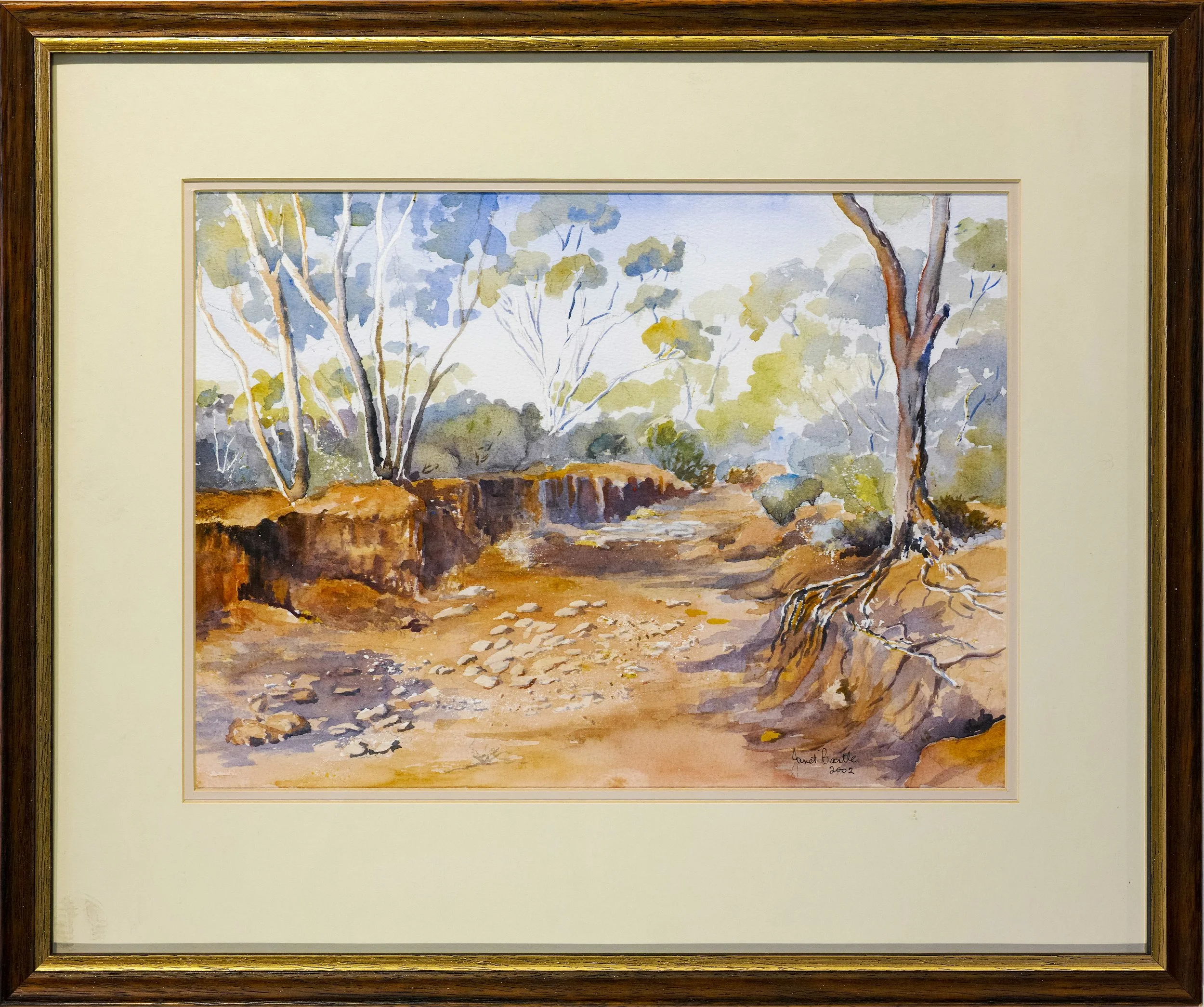
Run Off at Lake Douglas
Janet Bartle
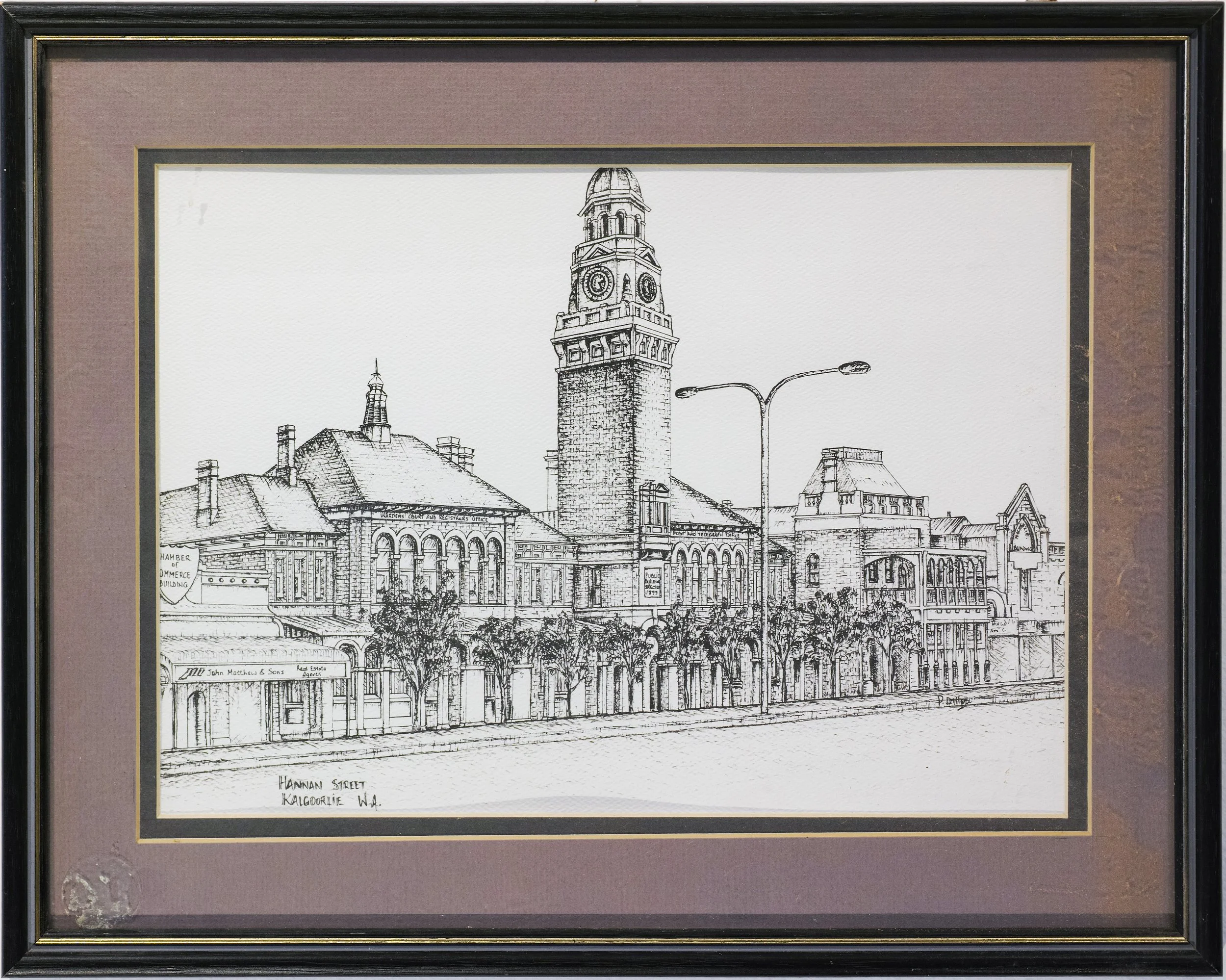
Hannan Street Kalgoorlie Post Office
Peter Dillon
Waterwashed pebbles are irresistible. In my story, Teresa collects a few pebbles on a momentous day and they become, for her, touchstones of change.
Carolyn Wadley Dowley is an author and historian. Her book ‘Through Silent Country’ (2000, 2023) tells the story of one of Australia’s greatest escapes, occurring right here in the WA goldfields. ‘Through Silent Country’, award-winning in 2000 and re-released in 2023, follows faint, nearly obliterated traces to track down government archival evidence of the escape as well as recording the strong voices and testimonies of Wongutha and Koara families who still held the knowledge of the events. Carolyn is currently working on telling the remarkable story of Matron Sadie Canning of Leonora Hospital.