

Preservation
Shane Pinnegar
“I was born in that house, y’know.”
The woman, who had thought she was alone, turned to the dark-skinned man slightly startled.
“What – what do you mean?” she asked, a slight quaver in her voice betraying her innate unease at talking with any stranger.
“That house in the picture, the one on the right. I was born there, lived there ‘til I was fifteen.”
She turned back to the pencil drawing hanging on the gallery wall and inspected it again. The houses it depicted were little more than one room shacks.
“It’s true, y’know,” he said, his voice quiet but genial, perhaps with a tinge of sadness to it. “Me and my Mum and Dad, my Gran, and 4 older brothers and sisters. Pretty small place, eh?”
She looked at him again and saw no sign that he was spinning her a yarn, so she looked back at the drawing. How could a family of – what did he say, eight? – live in such a tiny domicile? It was inconceivable to her. Where did they cook, watch TV of an evening, let alone have any space for themselves.
“I can’t even imagine how squished that must have been,” she said gently, choosing her words carefully, hoping not to offend.
The man barked a quiet laugh and nodded. “Yeah, it was squished alright.”
He smiled widely, his white teeth contrasting his skin the colour of milk chocolate. “But it wasn’t so bad – I was a lot smaller then, so I didn’t need as much room!”
She smiled, his warm grin infectious, melting her reservedness. “Whereabouts in Boulder is it?”
With a shake of his head he replied, “It’s gone now. They bulldozed it to make way for the Superpit in the 80’s. Wasn’t too far from the Boulder Block pub – that’s where Dad spent most of his time, so that left a little more room for Mum and Gran and us.
“I’d left home by the time the house was gone, anyway. Got a job up north on a cattle station, didn’t come back for almost ten years, not until Mum was pretty sick. Gran was gone by then – Dad wasn’t around much. So, I came back and looked after her for a while, but there wasn’t much I could do.”
“I’m sorry for your loss,” the woman said, surprised at the wave of sadness which washed over her. “At least you spent some time with her before… you know…”
The man nodded slowly, still staring at the drawing on the wall. “We all gotta go some time…”
The two stood in silence a short while, both contemplating the picture.
She marvelled at how different his childhood must have been from her own comfortable, roomy, suburban upbringing in Melbourne.
Eventually, he broke the silence, his voice barely a whisper. “I like to come back and look at this picture every now and then – whenever I can get away for a little while. They weren’t all good times in that house, but they mattered to us. We never had a camera in them days – there’s no photos of us or the house that I know about. Never had any money to spare, but Mum always made sure we’d have full bellies and a shirt on our backs and school books, even if most of it was secondhand. I reckon without this picture I’d have forgotten what the house even looked like.”
“I think that’s why artworks like this are so important,” the woman agreed. “They keep us grounded, remind us of where we came from, of a time that’s long gone. It matters, you know.”
The man nodded slowly again, a sad smile on his face.
The woman warmed to her theme, surprised at how chatty she suddenly felt. “Progress is important, of course, but tearing down buildings – people’s homes – in order to dig a hole in the ground… I hate that. It’s like they’re erasing memories – erasing history. I’m so glad you come back to look at this picture and preserve your memories against the relentless grind of time.
“I sometimes wonder what would happen if I lost all my photos, all my school reports, all the knick knacks that I have accumulated throughout my forty years – my whole history. Would my memory be strong enough to remember everything? Could I recall what a school friend looked like thirty years ago without a photo to reference, or what a place I visited in the ‘90s was really like?
“I even read an article not too long ago which said that photos are highly beneficial for people with dementia – they help them get back in touch with their personal history, not only memories, but positive feelings surrounding a time or place or event in their pasts.
“You know, you should ask if you could get a print of this drawing, keep it for yourself, always.”
“That’s a sweet idea, but I travel pretty light. Just my memories and me, really.”
She turned to the man again and saw the sadness within him more clearly as he looked at her. His hair was grey, his skin weathered, but his eyes were clear and bright, and his voice – although quiet – spoke with authority.
“It’s good that the house is gone – like I said, not all those memories were good, and all of us would have gladly moved to a bigger, cleaner, better house if we’d had the chance at the time.
“That progress you mentioned is important: the gold in the ground was worth far more than the houses, and I mean even the emotional history of them as well. Without the mine, there might not even be a town here any more. I reckon that’s a sacrifice worth making.
“The important thing is that you can’t stop progress. You can’t stop change. But I like that we can hold on to a few memories of simpler times, so I appreciate you listening to my story.”
She watched as the sadness lifted for a moment, his smile warmer and more gentle as his gaze returned to the drawing. Her eyes followed, glancing back at the picture and reflecting on his equanimity in the face of his family’s tumultuous history.
She turned back to the man and was startled that he was nowhere to be seen. She spun, looking around the empty room.
“You were right there just a moment ago,” she muttered incredulously, and walked from the room, looking for him in each room of the gallery, but there was no sign of the man anywhere.
She approached the security guard at the gallery door and asked if the man had exited the building, but the guard said she had not seen anyone of that description all day.
The woman made her way slowly back to the drawing they had been discussing, and she looked around the room again as a cold shiver ran down her spine.
“You come here when you can get away, huh?” she noted quietly to herself. “And you travel light – just you and your memories… interesting, my friend, very interesting.”
The woman looked back at the drawing, wondering if, for the briefest of moments from the corner of her eye, she had seen a young boy’s face peeking through one of the curtained windows in the picture, but she couldn’t be certain no matter how closely she peered at the artwork now.
She stood at the drawing for a long time after that, pondering the man’s words about change and history. If progress and change is inevitable, then the preservation of the history it leaves in its wake is more essential than ever.
She’d come to Kalgoorlie to assess this collection of art, certain that she was going to decline the offer to purchase it for the National Gallery, but she was now surprised to feel quite the opposite. After all, if change is inevitable and important, then perhaps the sacrifice shouldn’t be a human one, but a commitment to preserving a record of the history and the emotional memories – good and bad - of the lives that stood in that place, even if they were just one long-gone kid peeking through some curtains in a shanty shack on the edge of a desert town.
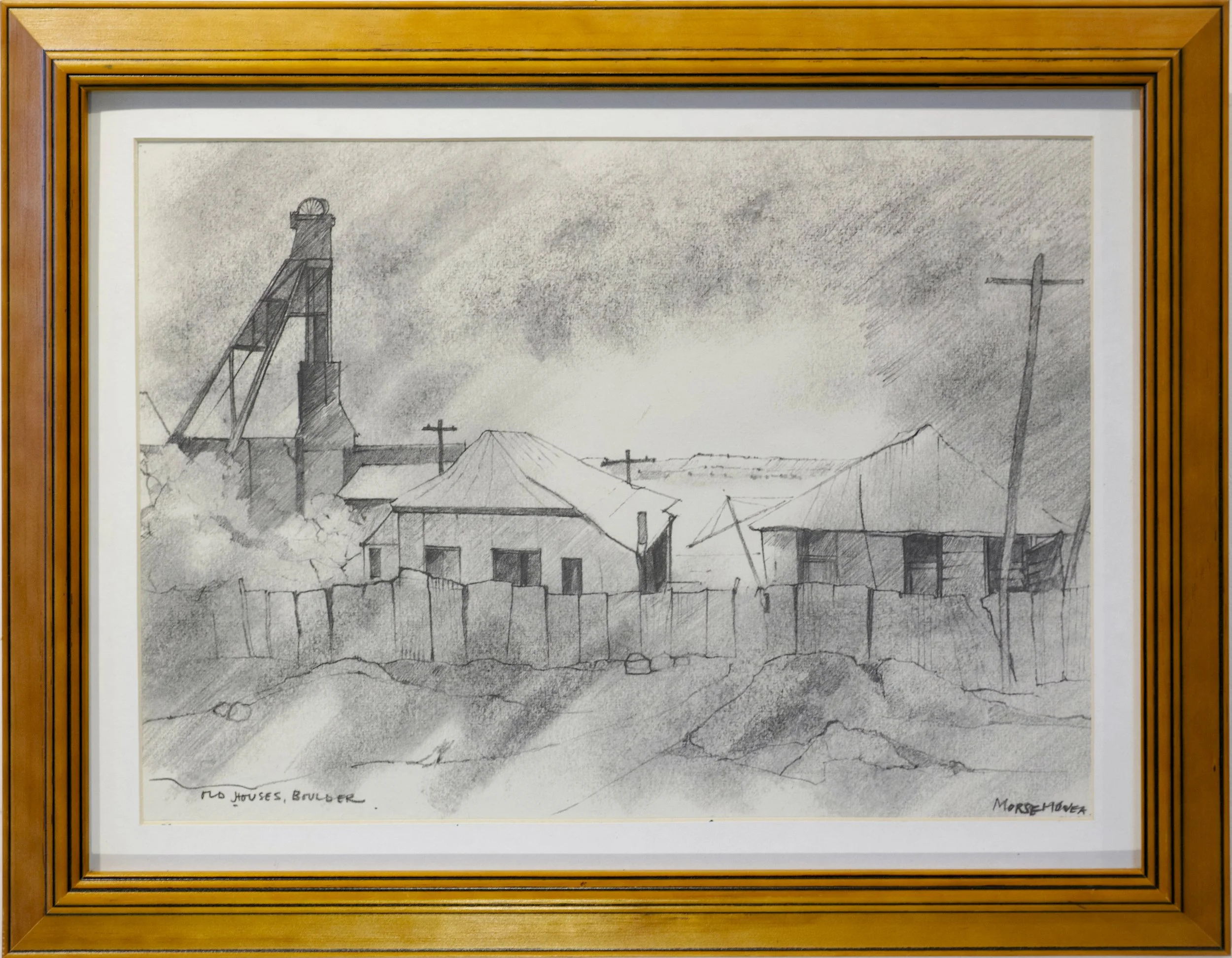
Old House, Boulder
Morse Hovea
This pencil drawing of an old house on the outskirts of Boulder with a headframe in the background evoked thoughts of the human lives and memories which we lose to progress. In part, this was inspired by several visits to Kanowna during the 4 ½ years we lived in Kalgoorlie – seeing the remains of a once-bustling town where people lived, fell in love, started families, where children went to school, made friends, played games, all long gone now apart from the ghosts of those lives.
Author, chef, caterer, ex-Kalgoorlie resident (2020-2024) Shane now lives back in Perth with his wife and two canine overlords where he is working on his fifth book and continues to cook up a storm.